
Tired of shade nets that fail after one season? Cheap options degrade and tear, costing your business more in replacements. The key to longevity isn't just material, but manufacturing quality.
A high-quality, well-made shade net1 can last from 5 to 10 years, sometimes even longer. Its lifespan depends directly on the quality of the weaving and finishing process2es, which ensure structural integrity3 and resistance to environmental stress like sun and wind.
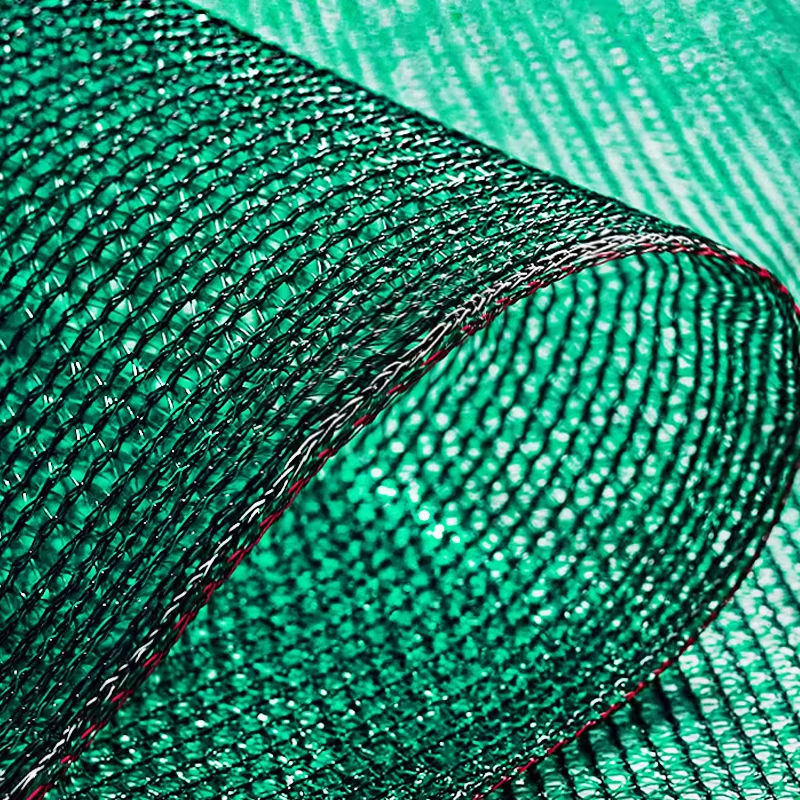
Many of our clients focus on the type of plastic or the UV treatment. Those things are very important, of course. But they are only part of the story. The real difference between a net that lasts a single season and one that protects assets for a decade happens on our factory floor. It's in the details of how thousands of individual threads become a single, strong fabric. Let's look at the steps that truly determine a shade net's lifespan.
Does the weaving process4 really affect a shade net's lifespan?
Have you ever seen a shade net with "waves" or uneven patterns? This isn't just a cosmetic flaw. It's a sign of poor weaving that weakens the entire structure.
Yes, the weaving process4 is fundamental to a shade net's strength and lifespan. A precise, consistent weave distributes stress evenly across the entire net. In contrast, poor weaving creates weak spots that will inevitably tear and fail under pressure from wind or sun.
Weaving is the process of turning countless individual threads into a unified net. The difficulty here lies in achieving perfect density and flatness. In my 20 years of experience, I've seen how tiny variations can lead to big problems down the line. It all comes down to control and precision.
The Importance of Weaving Stability
Modern shade nets are made on high-speed knitting or weaving machines. As these machines run, it's critical to maintain the exact same tension on every single thread. If the tension is off on even a few threads, the final net will have uneven density. This creates visible flaws like "waves" or "twill lines" that don't just look bad; they are structural weaknesses. Sensitive equipment, like our automatic stop-motion devices that detect a single broken thread, is essential. This ensures the integrity of the weave is perfect from start to finish.
How We Achieve Precise Shade Ratings
When a client orders a 70% shade net, they need exactly that. This rating is achieved by carefully controlling the weaving density and the width of the flat yarn threads. We have to calibrate our machines perfectly to ensure every batch meets the exact specification. This technical skill is a key indicator of a manufacturer's quality control. An inaccurate shade rating5 can ruin a crop or fail a building inspection, so precision is not optional.
| Weaving Quality | High-Performance Net (Our Standard) | Low-Quality Net (Common Failures) |
|---|---|---|
| Tension Control | Uniform tension on every thread | Inconsistent tension creates weak points |
| Final Appearance | Perfectly flat and even | "Waves", "ripples", or "twill lines" |
| Structural Integrity | Stress is distributed evenly | Weak spots prone to tearing under load |
| Shade Rating | Accurate and consistent across the roll | Inaccurate; varies from section to section |
Why is the finishing process2 critical for a durable shade net?
Ever had a net shrink after installation or fray at the edges? This happens when the final finishing process2 is rushed or done incorrectly. It's a critical last step.
The finishing process2 "locks in" the net's final properties. Heat setting stabilizes the weave to prevent shrinkage and warping. Edge reinforcement is crucial because the edges take the most strain during installation and from wind, preventing tears and extending the net's life.
After a net comes off the weaving machine, it's not ready for the field. We call this state "greige goods6." It's unstable. The final stage, which we call finishing, is what gives the net its strength and stability for years of use. This is where we solidify its performance.
Locking in Stability with Heat Setting
A freshly woven net is in an unstable state of stress. If you install it directly, it will shrink and deform under the sun and rain. To prevent this, every net must go through a heat-setting treatment. We pass the net through a long oven at a very specific temperature and speed. This process relaxes the plastic's memory and stabilizes the weave permanently. If the temperature is too high, the net becomes brittle. If it's too low, it won't be stable. Getting this balance right is a science we've perfected over many years.
Reinforcing the Weakest Link: The Edges
The edges, or selvedges, of a shade net are its weakest point. They are where grommets are installed and where the wind whips the hardest. A simple cut edge will tear almost immediately. That is why high-quality nets always have reinforced edges. This single step can be the difference between a net that lasts one year and one that lasts ten.
Here are the common reinforcement methods we use, depending on the customer's needs:
- Folding and Sewing7: A basic but effective method where the edge is folded over and stitched.
- Reinforcement Banding8: A strong webbing or band is sewn along the edge, providing a much stronger anchor point for installation.
- High-Frequency Welding9: This advanced method fuses the materials together, creating a seamless and incredibly durable edge for the most demanding applications.
Conclusion
A shade net's true lifespan is decided in the factory. From precise weaving to robust finishing, every manufacturing step is critical for creating a reliable, long-lasting product for your business.
Discover the factors that contribute to the longevity of a shade net, ensuring you make a wise investment for your business. ↩
Discover how the finishing process locks in a net's properties, preventing shrinkage and extending its lifespan. ↩
Understand the importance of structural integrity in shade nets to ensure they withstand environmental stress. ↩
Learn why the weaving process is crucial for the strength and lifespan of shade nets, preventing costly replacements. ↩
Find out how precise shade ratings are achieved and why they are vital for crop protection and building compliance. ↩
Understand the initial state of shade nets and why further processing is essential for stability and performance. ↩
Explore this basic yet effective method for reinforcing shade net edges, crucial for long-term durability. ↩
Learn about this strong method of edge reinforcement that provides a robust anchor point for installation. ↩
Discover this advanced method for creating durable edges, ideal for demanding applications. ↩